
Last updated August 25, 2026
Free on-site gate assessment - hinges, posts, and your LiftMaster or Nice gate operator checked before anything is quoted
The assessment is free and the quote is the invoice.

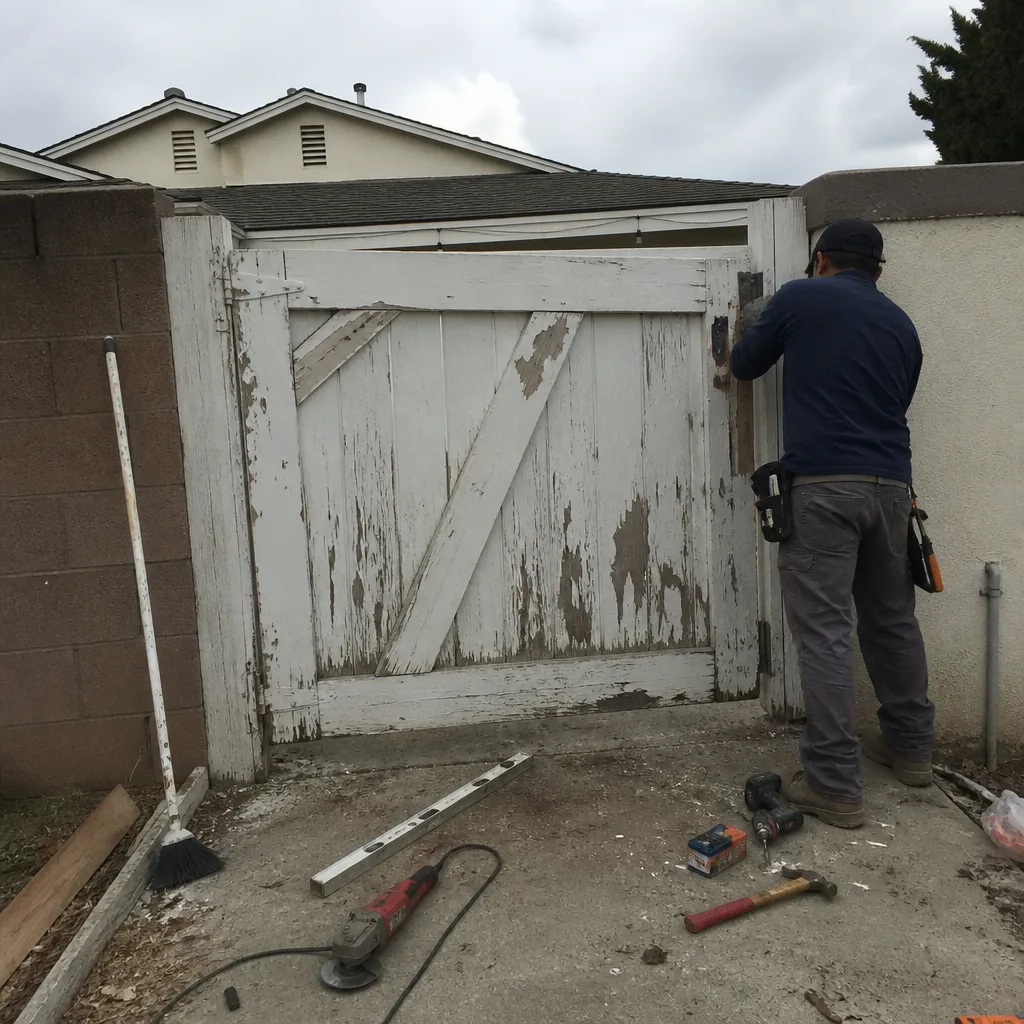 Before
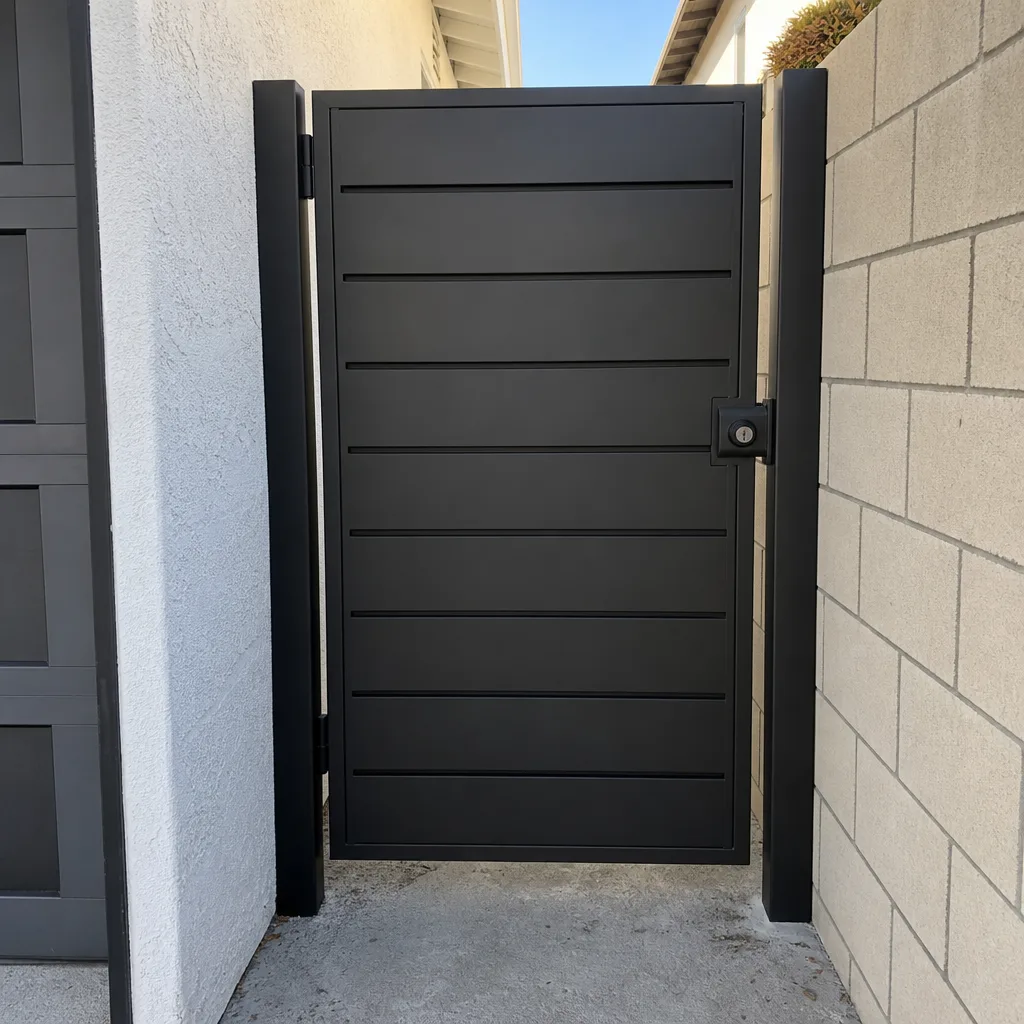 After
After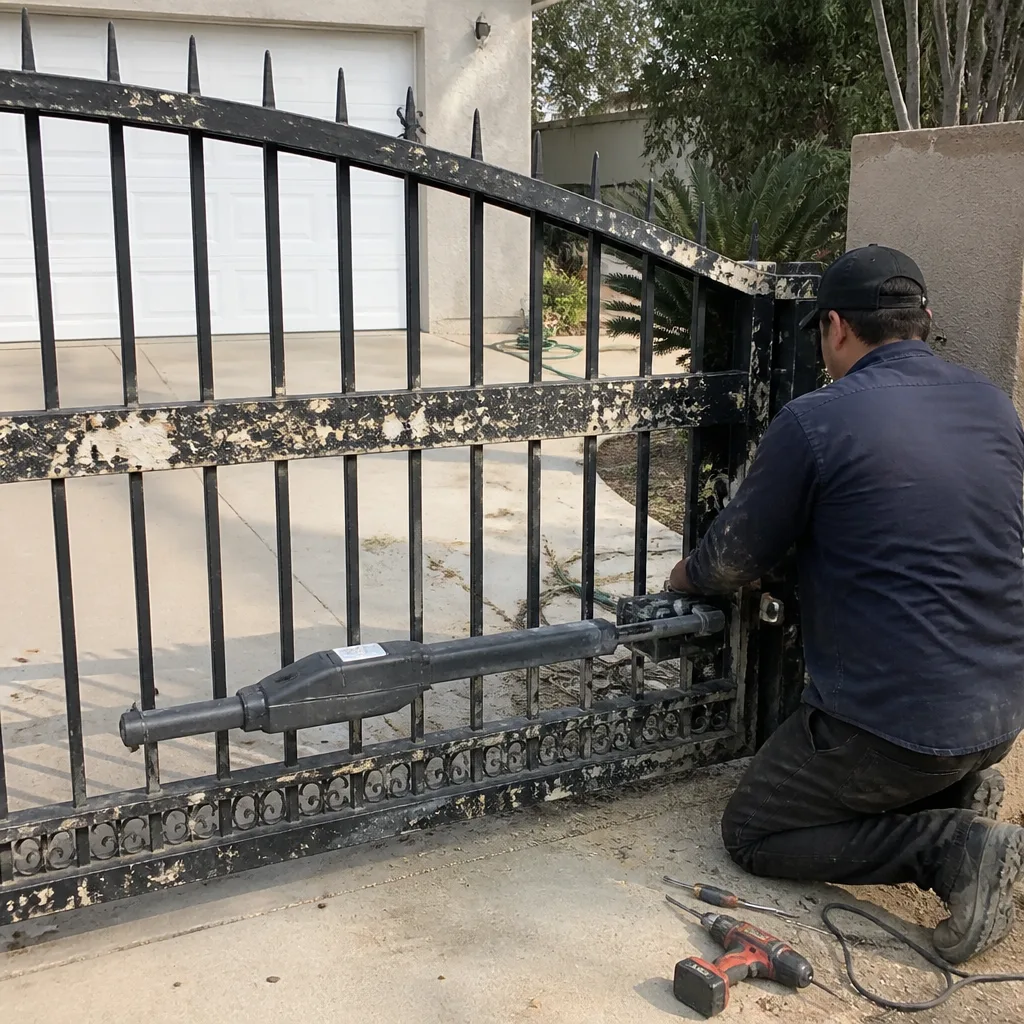 Before
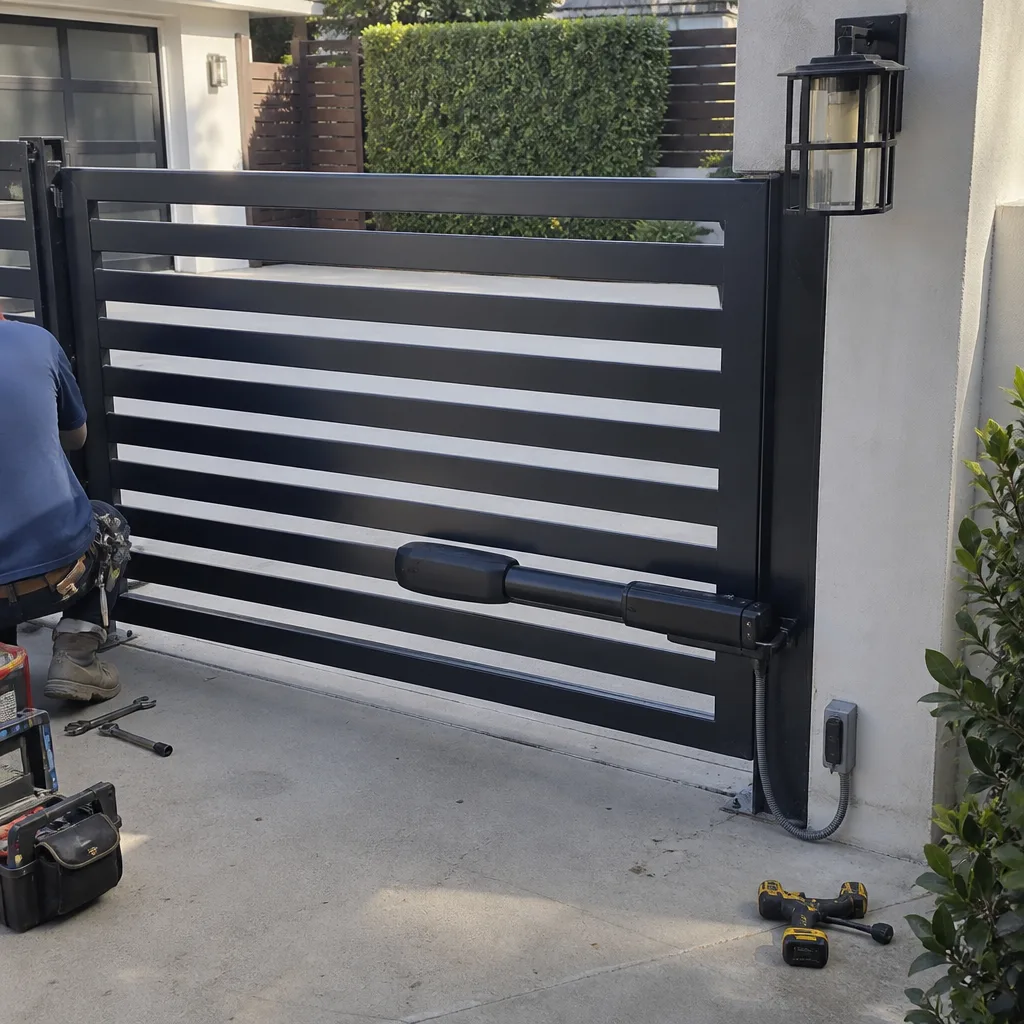 After
After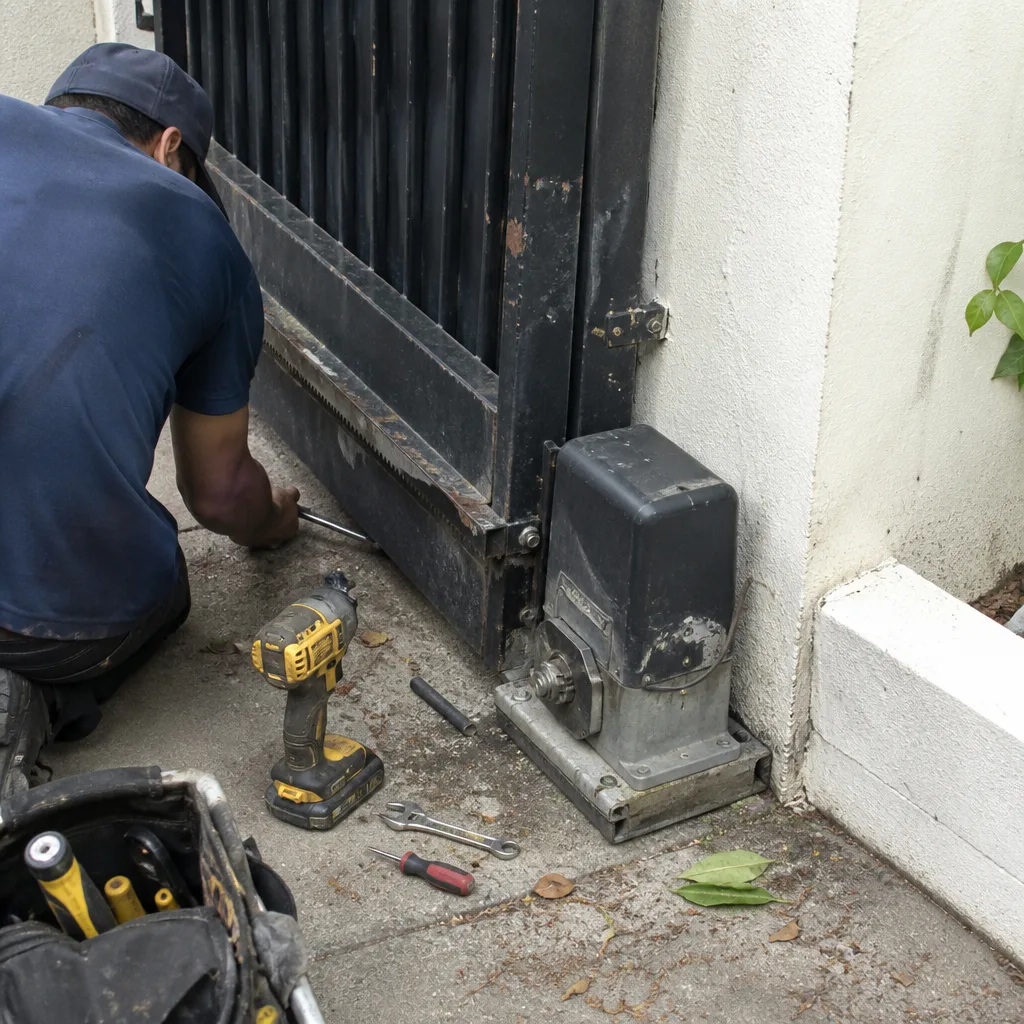 Before
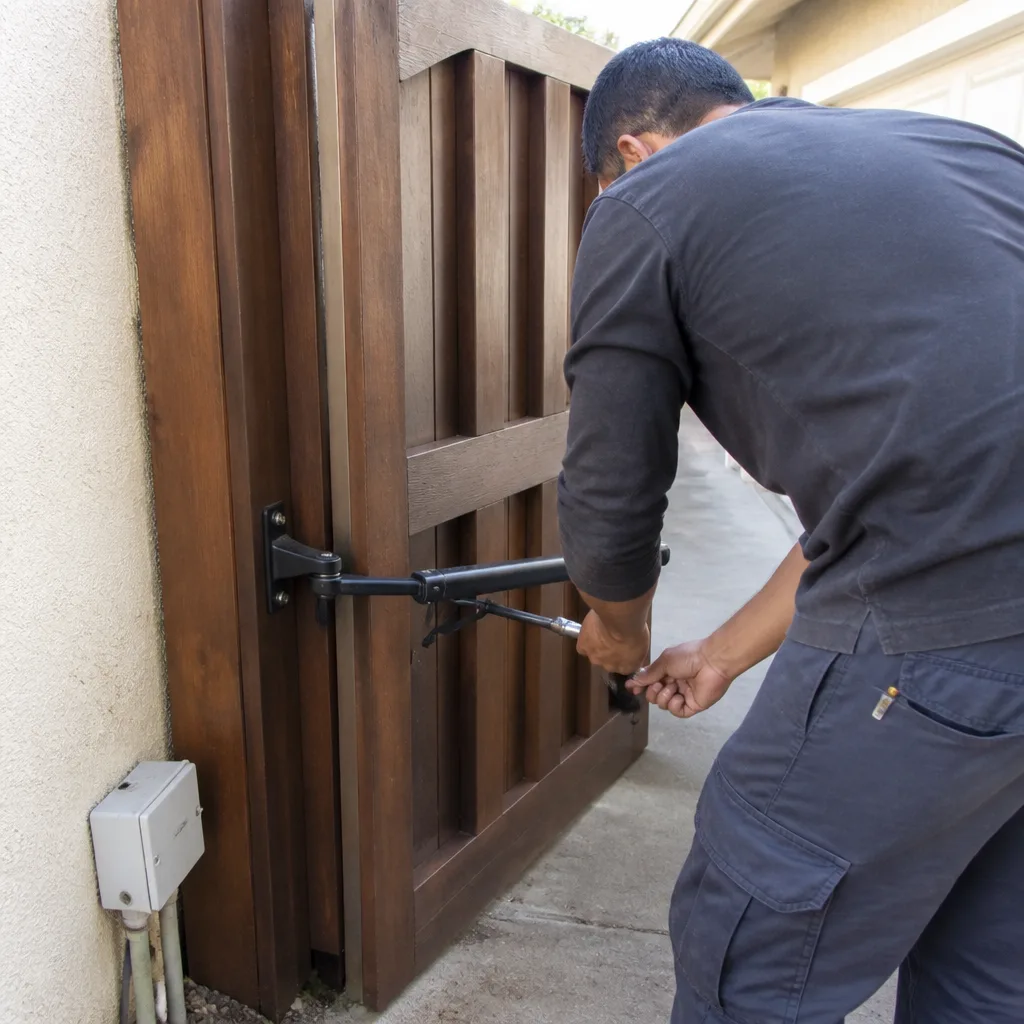 After
AfterDIY vs Professional Gate Repair: The Costa Mesa Homeowner’s Decision Guide
The average automatic driveway gate in Costa Mesa cycles open and closed roughly 150,000 times before its first major mechanical failure. That number surprises most homeowners, but it shouldn’t. What should surprise you is how many of those failures trace back to a simple decision made years earlier: who performed the last repair. We’ve followed behind more than a few well-intentioned DIY fixes that turned a $200 hinge job into a $1,800 motor replacement. This guide walks through what a Costa Mesa homeowner can safely handle, what they absolutely should not, what things actually cost in this market, and how to make the call without regrets. It covers spring-loaded hinges, salt air, the peculiar way a sea breeze treats cold-rolled steel in Mesa Verde, and the honest math between saving money now and spending much more later.
Quick Answer
For most Costa Mesa homeowners, light maintenance like cleaning tracks, tightening visible bolts, and checking safety sensors is reasonable DIY work. But any repair involving the gate’s counterbalance springs, motor, control board, welded frame, or underground wiring is best left to a professional. The risk is not just a botched fix. A badly repaired gate can injure someone or burn out a motor that would have lasted another decade. When in doubt, get a written estimate first, it costs nothing and tells you exactly what you’re dealing with.
Table of Contents
- What DIY Repairs Are Safe for a Costa Mesa Homeowner?
- What You Should Never Repair Yourself
- How Much Does Gate Repair Cost in Costa Mesa?
- The Real Risks of Getting It Wrong
- Why Gates Fail Differently in Costa Mesa
- Tools and Equipment You’ll Need for Basic Gate Maintenance
- The Hidden Cost of a Wrong Diagnosis
- How to Decide in Under 30 Minutes
What DIY Repairs Are Safe for a Costa Mesa Homeowner?
Let’s start with what you can actually handle without a service call. The dividing line is simple: if the part is accessible, visible, and not under load, it’s usually fair game. Costa Mesa’s dry climate works in your favor here. Unlike oceanfront Newport or Huntington, you’re not fighting rust every time you pick up a wrench. Most gates in the College Park and Halecrest neighborhoods dry out overnight instead of staying damp, which means bolts come loose rather than seizing up.
Safe DIY maintenance includes:
- Cleaning the track with a stiff brush and mild detergent, then wiping down the rail with a dry cloth. Dirt and grit from Mesa Verde’s older tree-lined streets works its way into the wheels and causes grinding.
- Tightening visible bolts on the gate frame, hinges, and the motor mounting bracket. Use a socket wrench, not a drill with the clutch too high. You want snug, not stripped.
- Checking the safety photo-eye sensors on either side of the gate opening. If they’re dusty or slightly misaligned, wipe them with a clean rag and nudge them back into alignment. This fixes a surprising number of “the gate won’t close” problems.
- Lubricating the hinge pins and wheels with a dry silicone spray. Avoid WD-40. It’s a water displacer, not a lubricant, and it attracts dust that turns into grinding paste. You’ll be doing this every month if you start.
- Testing the battery backup in your opener, if it has one. Unplug the motor and try to run the gate. If it’s dead, the battery is past its useful life. On most LiftMaster and Mighty Mule units, it’s a slide-out module sold separately.
- Removing cobwebs, leaves, and snail trails from the gearbox and motor housing. Costa Mesa’s coastal snails love the shade under a gate motor cover, and the slime corrodes aluminum housings over time.
A word on cleaning: do not use a pressure washer on any gate, especially not an automatic one. Water forces its way past the gearbox seals and into the control board enclosure. In Costa Mesa, where it rarely rains for months at a time, a pressure washer is the most common source of water damage we see on otherwise well-maintained gates.
What You Should Never Repair Yourself
Some repairs are simply not DIY territory. This is not gatekeeping from a tradesman. It’s physics and voltage and a healthy respect for what can go wrong in a single second. We have been called to Costa Mesa homes after a spring let loose and tore a section of gate off its hinges, after a homeowner opened a control board and found scorched wiring, after a weld failed and a 400-pound gate swung into a parked car. The injuries from gate failures are real, and they are permanent.
Leave these to a professional:
- Counterbalance springs and all tension-loaded hardware. Sliding gates have torsion springs inside the operator housing. Swing gates often use large extension springs at the hinge post. These springs hold hundreds of pounds of tension. If one releases while you’re working near it, there is no quick enough reaction. Do not unbolt a spring, do not “just tap it back into place,” and do not try to re-tension a spring that has come loose.
- Any work inside the motor or gearbox. Gate motors run on 110v or 220v. The capacitors inside hold a charge even after the breaker is off. Unless you’re trained on this equipment, the inside of a motor housing is not the place to learn.
- Control board replacement or rewiring. Modern gate openers are controlled by circuit boards that communicate with safety sensors, keypads, and obstruction detection circuits. A miswired connection can disable the auto-reverse safety feature. That’s the exact feature that prevents the gate from closing on a child, a dog, or a car.
- Welded frame repairs. If the gate frame is cracked, bent, or pulling apart at a weld, this is a structural repair. It requires a proper welder, the right rod, and the experience to match a repair to the original metal. A bad weld on a cantilevered gate looks fine for a year, then fails catastrophically.
- Underground wiring, conduit, and loop detectors. If your gate uses an underground loop detector to open for exiting cars, and it stops working, that’s a wiring issue under your driveway. Digging without knowing where the conduit runs is an expensive way to discover you’ve hit something else.
If any of these areas are involved in your gate’s failure, the smartest move is a phone call. You’ll get a straight answer about what’s wrong and what it costs, and nobody risks a hand or a gate motor in the process.
How Much Does Gate Repair Cost in Costa Mesa?
Gate repair pricing in Costa Mesa runs from about $120 for a simple sensor alignment up to $2,500 for a full motor and control board replacement on a high-end swing gate. Most jobs we see fall between $200 and $600. Here’s the honest breakdown of what you should expect to pay in this market, based on what we see across Eastside Costa Mesa, Westside, and Mesa Verde.
| Repair Type | Typical Costa Mesa Price Range | What’s Included |
|---|---|---|
| Safety sensor alignment or cleaning | $120-$200 | Labor, sensor adjustment, test cycle |
| Hinge replacement (single swing gate) | $250-$450 | New hinges, hardware, welding if needed, adjustment |
| Wheel or roller replacement (sliding gate) | $200-$400 per set | Wheels, axle bolts, track realignment |
| Gearbox or sprocket replacement | $350-$650 | New gear assembly, lubrication, motor test |
| Control board replacement | $400-$900 | Board, installation, programming, safety test |
| Full motor replacement | $1,100-$2,500 | Motor, bracket, wiring check, programming |
| Welded frame repair (crack or break) | $300-$1,000 | Weld, reinforcement plate, paint match if possible |
Every honest gate professional quotes a firm price before work starts. If someone is giving you a vague range and then billing you hours beyond it, that’s a red flag. Ask for a written estimate. A square deal means you approve the number before a single bolt gets turned.
The Real Risks of Getting It Wrong
A DIY repair that goes wrong rarely announces itself right away. The gate will still open. It’ll still close. Maybe it hums a little differently, or it slows down near the end of the travel. Then three weeks later, the motor overheats and burns out because a bolt you tightened a half-turn too far put the whole drive train under friction. Or the gate reverses for no reason because a wire you nicked finally grounded out. Or worse: the gate fails to stop when it should.
The risks fall into three buckets:
- Personal injury. Gates are heavy. Even a lightweight aluminum residential gate weighs 300 to 500 pounds. An iron estate gate can top 1,200. When a spring, cable, or hinge fails, that weight moves instantly. We have seen the aftermath of these failures on Costa Mesa driveways. They are not something you can outrun.
- Equipment damage. A tiny mistake in one component cascades into expensive failures in others. A misaligned rail wears out wheels. A loose mount bracket rattles the gearbox until the teeth strip. A wrong capacitor swap fries the control board. The $80 you saved quickly becomes an $800 replacement.
- Voided warranties and insurance claims. Most gate opener manufacturers void their warranty if the unit is opened or worked on by an untrained person. Your homeowner’s insurance may also look closely at a DIY gate repair that led to property damage or injury.
The math is not complicated. If a professional repair costs $400 and a DIY attempt costs $80 in parts but has a meaningful chance of causing an additional $900 in damage, the DIY option is not the bargain it looked like on the shelf at the hardware store.
Why Gates Fail Differently in Costa Mesa
Costa Mesa’s climate is a strange beast for metal and electronics. We are two miles inland from the Pacific. That’s close enough to get marine-layer moisture in the air every morning from June through September, but not so close that everything rusts through in five years like it does right at the beach in Newport. The result is a slow, persistent kind of corrosion that surprises homeowners who moved here from drier inland cities like Riverside or Corona.
What we see over and over across Costa Mesa:
- Galvanic corrosion at the hinge post. When steel hinges bolt to an aluminum gate, the two dissimilar metals create a small electrical current in the presence of moisture. The morning marine layer supplies the moisture. The result is white oxidation and pitting where the hinge meets the gate. This is the single most common repair call we get from neighborhoods north of Adams Avenue.
- Control board corrosion from condensation. The temperature swing between a cool Costa Mesa night and a warm inland afternoon causes condensation inside the motor housing. Over time, moisture settles on the control board and corrodes the solder joints. Symptoms include intermittent operation, phantom error codes, and a gate that works fine in the afternoon but not in the morning.
- UV damage to wiring insulation. While we don’t get an extreme amount of rain, we get a lot of sun. Exposed low-voltage wiring, especially near the gate’s keypad or sensors, breaks down from UV exposure over several years. The insulation becomes brittle and cracks. Then the wire shorts against the frame.
- Soil movement and shifting gate posts. Costa Mesa’s clay-heavy soil expands and contracts with moisture. After heavy winter rains, especially around the Fairview Park and Canyon Park areas, gate posts can shift slightly, throwing the gate out of square. If the gate starts binding, look for a hairline crack in your driveway near the gate post.
These are local conditions, and they matter when you’re diagnosing a problem. A YouTube video from a guy in Phoenix has never seen a marine layer. A professional who works in Costa Mesa every week sees marine layer damage constantly, and that familiarity is why the diagnosis takes ten minutes instead of a weekend of online research.
Tools and Equipment You’ll Need for Basic Gate Maintenance
If you’re going to handle the light maintenance work yourself, you don’t need a workshop full of machinist tools. But you do need the right basics, and most Costa Mesa homeowners already have about half of this in the garage.
- A socket set with deep sockets. Gate hardware uses long bolts, and a shallow socket can’t reach the nut. You’ll want both SAE and metric. The gate could have been made in 1984 with standard bolts or last year with metric hardware.
- A torque wrench or a drill with a reliable clutch. Gate frame bolts should be snug. Over-tightening warps the frame and strains the motor. If you’re going to use a drill, set the clutch low and finish by hand.
- A wire brush and a can of dry silicone spray. The brush is for cleaning rust and grime off the rail and hinges. The silicone is for lubrication. Not WD-40, not white lithium grease, not motor oil. Silicone only.
- A multimeter. For testing battery backup voltage and continuity on low-voltage wiring. A basic $30 meter from any hardware store is enough. You don’t need a Fluke.
- A level and a rubber mallet. For checking gate alignment and nudging components without denting the metal. Soft mallet, not a steel hammer.
- Safety glasses and work gloves. You only get one set of eyes. Metal splinters and spring fragments don’t care how careful you were trying to be.
If you’re missing more than a couple of these items, the cost of a professional repair starts to look very reasonable compared to a trip to the tool aisle.
The Hidden Cost of a Wrong Diagnosis
Here’s a scenario we see every month in Costa Mesa. A homeowner calls, tells us the gate motor burned out, and asks for a replacement quote. When we arrive, we find the motor is fine. The real culprit is a bad capacitor, a corroded wiring connector, or a wheel that seized and overloaded the motor. Total repair cost: $150, which would have been a whole new motor and board if they’d followed their initial guess.
The opposite happens too. Someone replaces a capacitor or a photo-eye sensor because a forum post told them to, and the gate works for a week before failing again. The underlying problem, a gearbox full of metal shavings or a worn drive belt, was never addressed. Now they’ve paid for a part they didn’t need, and the real repair still awaits.
Diagnostics are the most undervalued part of any trade, and gate repair is no exception. A professional who has worked on hundreds of gates in Costa Mesa knows what a marine-layer-corroded control board looks like, what a bad wheel sounds like on a cold morning, and what a stressed motor smells like. That pattern recognition is not something you can replace with an hour of research. It comes from repetition, year after year, on every brand from Ghost Controls to Elite to DoorKing.
This is why we charge for diagnosis the way we do: as part of the job, not as a standalone gate-keeping fee. If you call for an estimate, we come out, find the actual problem, and hand you a written quote before any work happens. You’ll know exactly what’s wrong and what it costs to fix, whether or not you hire us. That’s how the last gate company on your list should operate.
How to Decide in Under 30 Minutes
If you’re standing in the driveway looking at a gate that won’t open or a panel that’s sagging, and you need to make a decision today, run through this simple sequence. It works whether you live in College Park, Westside Costa Mesa, or up near the bluff at Fairview.
Step one: Ask what the gate is doing wrong, specifically. Does it not open at all? Open slowly? Open but not close? Grind, squeal, or rattle? If the answer is “it stopped working entirely,” check the obvious first: the breaker in the main panel, the battery backup switch on the motor, and whether the keypad has power. Five minutes, and sometimes that’s the whole repair.
Step two: Ask what part of the gate is involved. If the problem is on the mechanical side, hinges, wheels, springs, track, or weld seams, and you cannot see an obviously loose bolt, call a professional. Mechanical failures under load are not DIY material.
Step three: Ask what tools and parts you’d need for your best guess. If the list is longer than a socket set and a can of spray, or if the parts cost more than $150, the professional route is likely cheaper by the time you factor in your own time and the risk of buying the wrong part.
Step four: Call for a free estimate before you decide. You’re not committing to anything. A real gate company in Costa Mesa will give you a clear, written diagnosis and a firm price. Then you can compare that number to your DIY estimate with actual facts instead of guesses.
That last step is the one people skip because they don’t want to feel obligated. But there’s no obligation in an estimate. A good contractor will tell you if the repair is easy enough to do yourself. We have talked homeowners out of hiring us more than once because the fix was genuinely simple. That’s how a company earns the right to be the one you call when it isn’t.
Common Mistakes to Avoid
- Starting the job without checking the breaker. We get calls from Costa Mesa homeowners whose gate was completely dead, and the fix was a tripped breaker in the garage subpanel. Check the easy things first. Always.
- Using WD-40 on gate hardware. It seems right, but it’s a water displacer, not a lubricant. It dries out quickly, leaves a sticky residue, and attracts dust. Use dry silicone spray instead, and only on the hinge pins and wheels.
- Buying the cheapest motor on Amazon. The knockoff operators sold online are cheap for a reason. They’re not built for outdoor use in a marine-layer climate, and when they fail, they fail in the open position. A used or refurbished Ghost Controls or Mighty Mule from a reputable source is almost always the better buy.
- Ignoring a noisy gate. Noise is a symptom. A squeal means a dry wheel or hinge. A grind means metal on metal somewhere. A hum without movement means the motor is stalled against resistance. Each of these is a $100 repair today and a $900 repair in six months.
- Leaving the gate on manual release indefinitely. If your gate won’t open automatically and you’ve pulled the manual release to push it open by hand for a few days, that’s fine as a temporary measure. But every week it stays on manual is a week that weather and dirt and opportunistic misuse are working on the exposed drive train. Fix the real problem. Soon.
- Mismatching parts on a multi-gate property. If you have two gates, one at the street and one at the driveway apron, the openers don’t have to match visually, but they do have to be compatible with your access control system. Mixing brands without checking compatibility leads to remote controls where one button opens both gates randomly and the other button does nothing.
When to Call a Professional
Call a professional if the gate is making a grinding noise, if the motor hums but the gate doesn’t move, if a spring or cable looks loose or broken, if the gate is sagging or dragging, if the keypad behaves erratically, if the gate reverses for no reason, or if you smell burning near the motor. Any of these indicates a problem that will not fix itself and will get more expensive the longer it waits. If the gate is jammed open and you need it secure tonight, the urgency speaks for itself. A live person answers the phone around the clock, and the call costs you nothing. Ironworks Gate Co. offers free estimates throughout Costa Mesa. Call (213) 754-8947 and you’ll get a real person, a straight answer, and a firm price before any work begins.
Frequently Asked Questions
Most gate repairs in Costa Mesa cost between $200 and $600, with simple fixes like sensor alignment running about $120 and full motor replacements reaching $2,500 on high-end systems. The price depends on the gate type, the part that failed, and whether welding work is required. Ask for a written estimate before approving any work so the final invoice is exactly what you agreed to.
If you are not trained on electric gate openers, no. The motor housing contains capacitors that store an electrical charge even with the breaker off, and a miswire can disable the auto-reverse safety feature. The inside of a motor is not a place to learn by trial and error. Call a professional with experience on your brand, whether that’s Ghost Controls, Mighty Mule, or a commercial unit from DoorKing.
Intermittent gate operation in Costa Mesa is usually caused by corrosion on the control board from morning marine-layer condensation, a loose wiring connector, or a battery backup that is no longer holding a charge. The fix is often simple, a connector clean and reseat, or a board replacement on older units, but the diagnosis requires opening the motor housing and testing the connections.
A quality gate opener installed in Costa Mesa should last 10 to 15 years with regular cleaning and lubrication, though the marine layer can shorten that lifespan for openers that are not properly sealed or maintained. The motor usually outlasts the control board, which is the part most affected by condensation. A seasonal tune-up each spring and fall extends the life of both components.
Depends on the repair. A $150 capacitor replacement is absolutely cheaper than a new opener. A seized gearbox plus a corroded board plus a tired motor is a different story. A good technician will tell you honestly when your opener has crossed the line from worth fixing to better off replaced, and will not sell you a motor you don’t need.
We handle the full system, from the gate frame and hinges to the motors, keypads, loop detectors, and access control panels. If your gate is automated, the mechanical side and the electronic side have to talk to each other correctly. One company handling both means one person accountable for the whole job, and one number to call if anything acts up later at (213) 754-8947.
The Bottom Line
A gate is not like a fence. It moves. It carries weight. It runs on electricity. And when it fails, it fails in the path of cars, kids, and delivery trucks. The Costa Mesa homeowner’s decision comes down to this: light maintenance and cleaning are yours to handle, but anything under tension, under voltage, or under weight is a professional’s job. A good gate company gives you a free diagnosis, a firm price, and a written guarantee. If yours doesn’t, you have the wrong company. If you have a gate that’s acting up, call (213) 754-8947 for a free estimate from Ironworks Gate Co. home. We’ll be there when we say, and we’ll stand behind the work in writing.
Written by Victor Salinas, Owner at Ironworks Gate Co., serving Costa Mesa since 2013.